Pre-Writing Strokes by Age: What to Expect from 2 to 5
Before children write letters, they learn a small set of simple strokes: lines, circles, crosses and a few shapes. Almost every letter and number is built from them, so these strokes are the quiet groundwork for writing later on.
Children tend to learn the strokes in a fairly predictable order, from straight lines to curves to shapes with corners and slants. The ages below are typical, not deadlines. Every child is different, and a few months either way is completely ordinary. Use this guide to choose the next fun thing to try, not to grade your child.
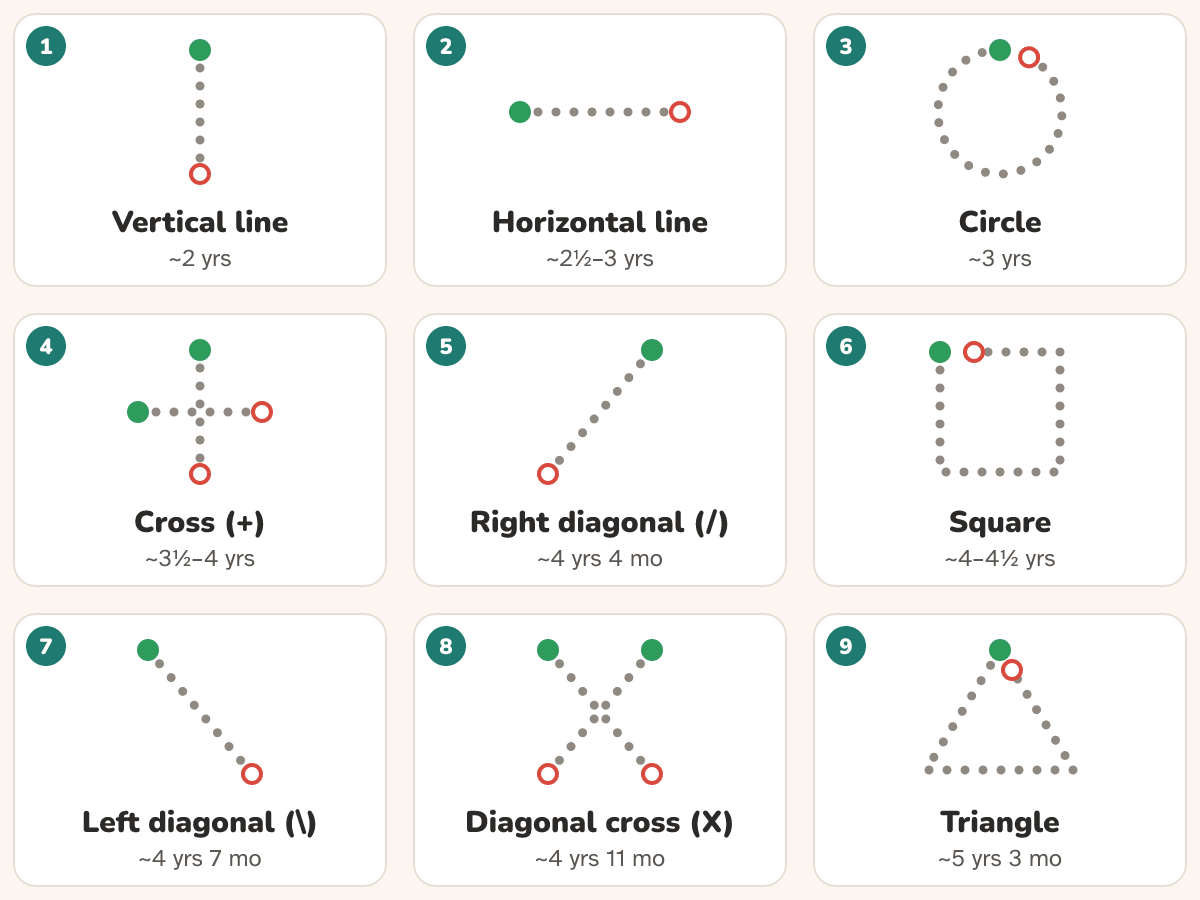
Imitate first, then copy
You will often see two words in this area: imitate and copy. They sound alike but mean different things.
A child imitates a stroke when they watch you draw it and then draw it themselves. Your hand shows them where to start, which way to go and when to stop. A child copies a stroke when they look at a finished example, like a circle already on the page, and draw it without seeing how it was made. Copying is harder, because they have to work out the moves on their own.
Imitation usually comes first, often several months before copying. So if your child can’t yet imitate a shape while watching you, it’s too early to expect them to copy it from a picture. Draw it slowly beside them, say the moves out loud, and let them have a turn. The ages in the table are for copying.
Typical order and age
| # | Stroke | Typical age |
|---|---|---|
| 1 | Vertical line | ~2 yrs |
| 2 | Horizontal line | ~2½–3 yrs |
| 3 | Circle | ~3 yrs |
| 4 | Cross (+) | ~3½–4 yrs (about 4 yrs 1 mo) |
| 5 | Right diagonal (/) | ~4 yrs 4 mo |
| 6 | Square | ~4–4½ yrs |
| 7 | Left diagonal (\) | ~4 yrs 7 mo |
| 8 | Diagonal cross (X) | ~4 yrs 11 mo |
| 9 | Triangle | ~5 yrs 3 mo |
The diamond is usually closer to 6, after the triangle. Ages are approximate and vary from child to child.
Age 2: lines and lots of scribbling
Most two-year-olds are still enjoying big, loose scribbles, and that is exactly what they should be doing. Around this age many children start to imitate a vertical line, and some begin to copy one from an example by about two. A horizontal line usually follows a little later.
Expect strokes that wander, overshoot the page and change direction halfway. The goal is a happy, confident mark, not a straight one.
Play ideas
- Tape a large sheet of paper to a wall or an easel and draw “rain” falling from the top down together. Working on an upright surface helps little wrists and shoulders do the job.
- Use chunky crayons or thick sidewalk chalk outside, and make long roads from one side to the other for a toy car.
- Spread a little shaving foam on a tray and draw lines with one finger. It wipes clean, so nothing is ever wrong.
Practice with

Age 3: circles join in
Three is a big year for drawing. Many children copy a horizontal line confidently by now, and the circle usually arrives around three. Early circles are often lumpy or don’t quite close, and that’s fine. The important part is going around and coming back near the start.
Some children also start to imitate a cross, especially if you draw it beside them one stroke at a time.
Play ideas
- Draw circles big before small: in the air with a whole arm, then on a large sheet, then on regular paper.
- Turn circles into things: a sun, wheels on a bus, a face. A reason to draw makes the practice feel like play.
- Trace around a cup or lid with a crayon, then try the same circle without the cup.
Practice with

Age 4: crosses, squares and first slants
Four-year-olds often bring several new strokes together. The cross (+) is commonly copied a little after four, the right diagonal (/) a few months later, and the square somewhere between four and four and a half. Squares are tricky because the pencil has to stop and turn at each corner.
You may notice that your child can draw each part but mixes up the order or direction. That’s a normal step on the way.
Play ideas
- Make a cross with two strokes and give each a name: “down like rain, across like a road.”
- Build a square from four craft sticks first, then draw around it, then draw it on its own.
- Use chalk on a fence or a big paper roll on the wall for slanted “slides” from the top corner down.
Practice with

Age 5: diagonals, X and triangles
Around four and a half to five, many children copy the left diagonal (\) and then the diagonal cross (X). The triangle often comes a little after five, because it combines two slants and a straight line with sharp corners.
By now drawings start to include recognizable people, houses and letters from their own name. Keep the focus on enjoyment and on trying new shapes, rather than on neatness.
Play ideas
- Draw an X as two slides that meet in the middle, starting each one at a top corner.
- Make triangles into roofs, mountains and slices of pizza, first big on an easel, then smaller on paper.
Diagonal (slanted) lines can be practiced with our Slanted line worksheets or the Lines pack ($5.99), which has a big and a small page of slants. The diagonal cross (X) and the triangle are best practiced with crayon and paper for now: draw one slowly, then let your child have a turn. Zigzags and winding roads are good warm-ups too, since every zigzag is made of short slants.
Practice with
When to check in
Children grow in bursts, and a child who skips a stage one month may race ahead the next. Still, you know your child best. If your child is well behind these ranges, avoids drawing completely or seems frustrated and upset when they try, it’s worth mentioning to their pediatrician or an occupational therapist. They can take a closer look and suggest ideas that suit your child.
This guide is general information to help you choose activities. It isn’t medical or developmental advice. Read our disclaimer for more.
Questions parents ask
What should a 3-year-old be able to draw?
Many three-year-olds can copy vertical and horizontal lines and are starting to draw circles, though the circles may be uneven or not fully closed. Some can imitate a cross when they watch you draw it first. A child who is a little earlier or later than this is still well within the usual range.
Should my 2-year-old trace?
Tracing can be fun at two if it stays playful. Big, short lines with large dots work best, and free scribbling, chalk and finger painting matter just as much. If your child would rather scribble over the page, let them: the practice still counts.
What’s the difference between imitating and copying a shape?
Imitating means drawing a shape right after watching you draw it. Copying means drawing it from a finished example, without seeing how it was made. Imitation usually comes first, so practice a new shape by drawing it together before expecting your child to copy it from a picture.
Does the order matter?
The order is a helpful guide, because each stroke builds on the ones before it. Straight lines come before circles, and circles before shapes with corners and slants. There’s no need to drill one stroke before trying the next. Follow your child’s interest and come back to the trickier strokes later.